
The most popular platforms aren’t always the most profitable. An Instapage survey of 1,440 marketers found that while 87% use Google or Meta Ads, only 44% report Google as their top performer, and just 25% cite Facebook. The disconnect isn’t the platform—it’s what happens after the click.
Here’s the problem: your landing page takes 4 seconds to load on mobile. Research shows a 1-second delay can reduce conversions by up to 20%. Meanwhile, average cost per lead climbed from $66.69 in 2024 to $70.11 in 2025. You’re paying more for clicks that bounce before converting.
This guide covers the best online advertising platforms for 2026, how to choose based on your goals, and how to improve ROAS after the click with dedicated landing pages and experimentation using landing page optimization strategies.
Key Takeaways
- Start with 1-2 platforms and validate conversion rate before expanding.
- Match your ad headline to your landing page headline exactly.
- Build dedicated pages instead of sending traffic to a homepage. Learn more about landing pages here.
- Test lower-competition platforms: Microsoft, Amazon, LinkedIn offer better CPCs.
- Fix mobile page speed before scaling budget, 1 second costs 20% conversions.
- Use Instapage landing page templates to quickly build campaign-specific pages.
What are online advertising platforms?
Online advertising platforms are digital services that allow businesses to create, manage, and optimize paid ad campaigns across the internet. These platforms connect advertisers with audiences on search engines, social media networks, ecommerce sites, and publisher websites.
Unlike organic marketing, online advertising operates on a pay-per-performance model.
- CPC (Cost Per Click): You pay each time someone clicks your ad.
- CPM (Cost Per Thousand Impressions): You pay for every 1,000 times your ad is shown.
- CPA (Cost Per Acquisition): You pay only when a specific action occurs.
The best online advertising platforms provide targeting controls (keywords, demographics, interests, behaviors), creative formats (text, image, video), and measurement tools to track performance and optimize campaigns.
Google Ads and Meta Ads: still the foundation for many teams
Our survey of 1,440 marketers found that 87% use either Google Ads or Meta Ads (Facebook and Instagram). These platforms dominate because of reach, targeting sophistication, and years of advertiser familiarity. However, “most used” doesn’t always mean “highest ROAS”, 44% of respondents reported Google as their top-performing platform, and 25% cited Facebook.
Google Ads
Google Ads captures high-intent searchers when they’re looking for what you sell. With access to over 90% of global search traffic, Google Ads offers multiple campaign types:
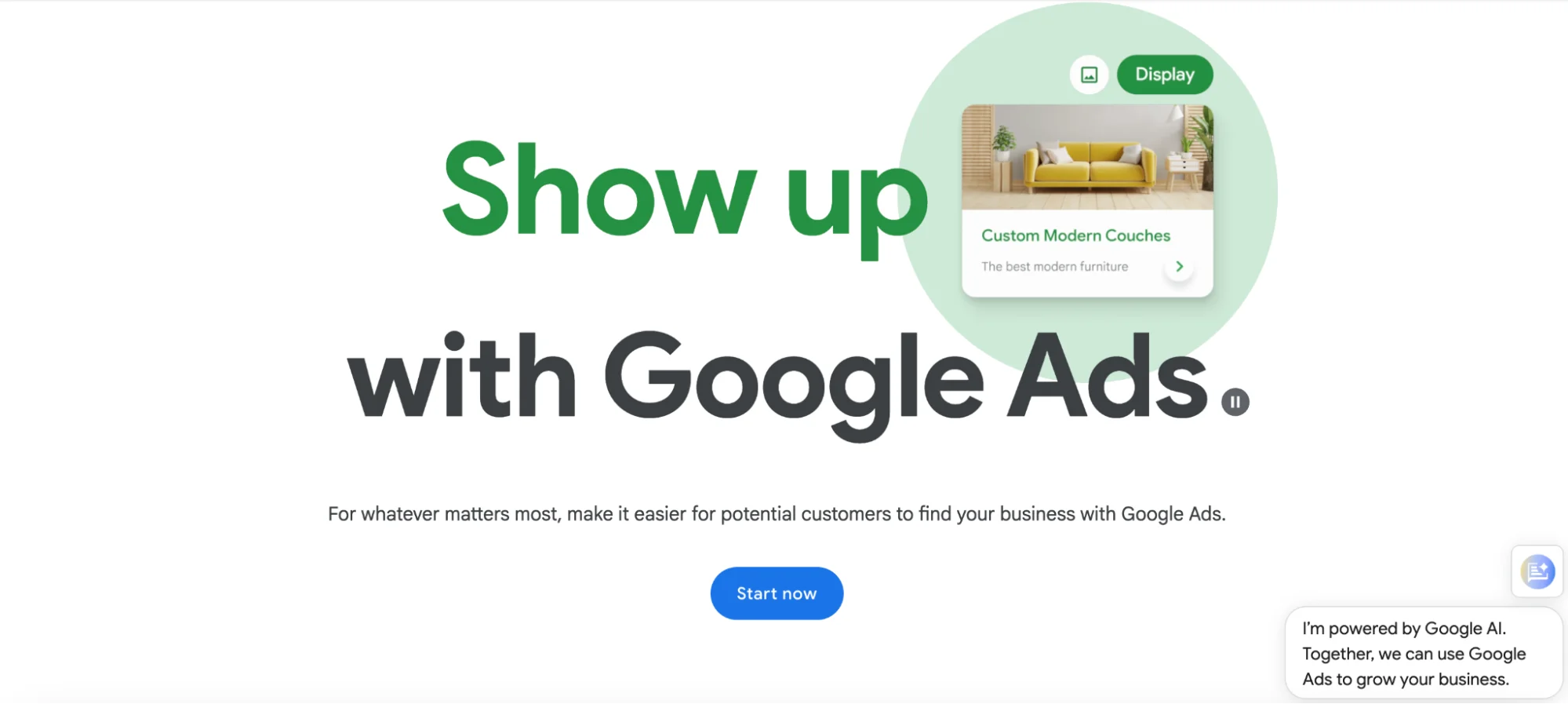
- Search campaigns: Text ads triggered by keyword searches
- Shopping campaigns: Product listings with images, prices, and merchant info
- Display campaigns: Visual ads across the Google Display Network
- YouTube ads: Video ads across the world’s second-largest search engine
- Performance Max: Automated campaigns serving across Search, Display, YouTube, Gmail, and Maps
Google Ads works best when you have clear, intent-based keywords and a conversion-tracking system in place. The platform rewards relevance with Quality Score, which directly affects your cost per click and ad position.
Meta Ads (Facebook and Instagram)
Meta Ads includes Facebook and Instagram advertising managed through a unified platform. Meta’s strength is audience targeting based on demographics, interests, behaviors, and lookalike modeling.
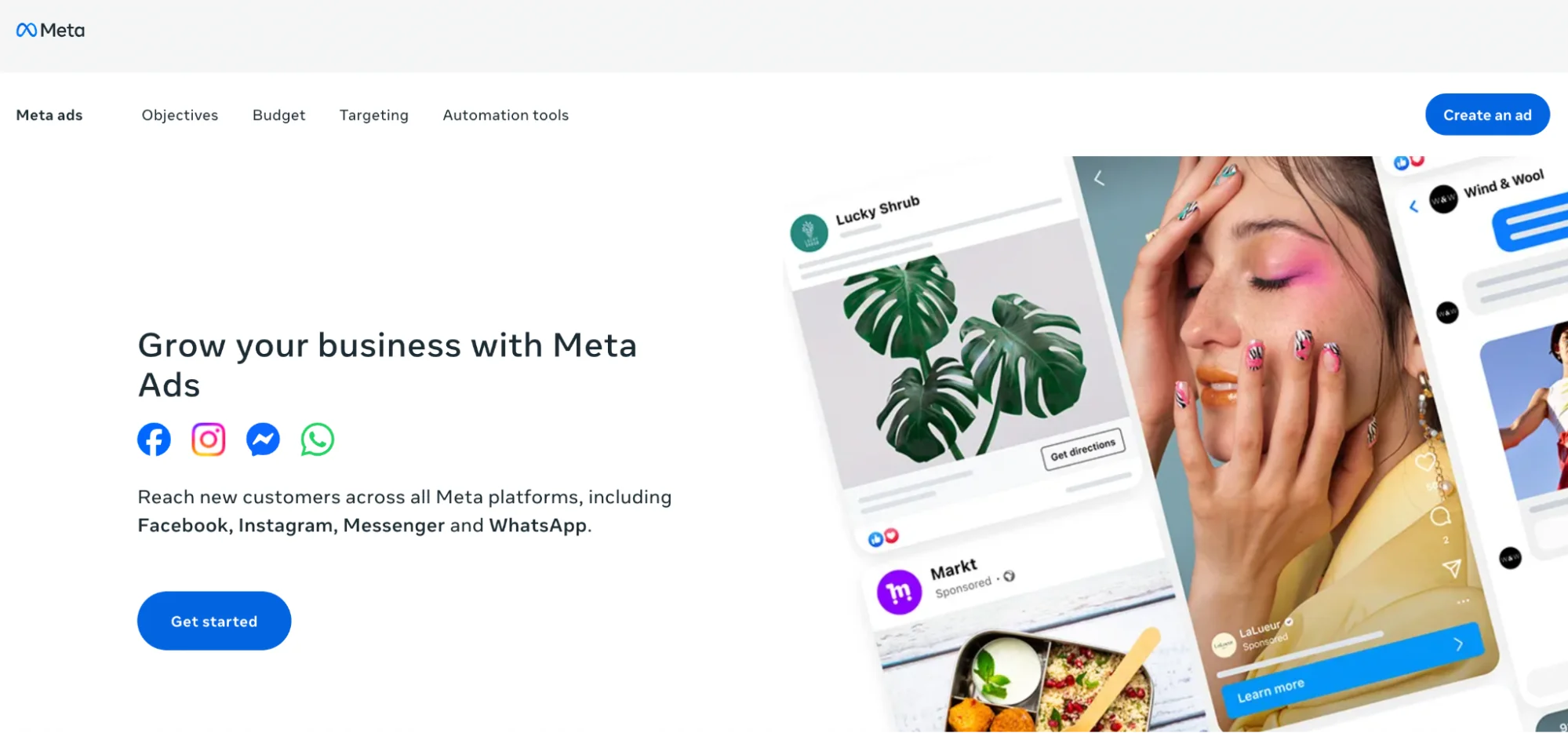
Our survey found that 80% of marketers use Instagram for advertising, though only 9% reported it as their top-performing platform. The platform works well for:
- Visual products and services: Apparel, home goods, travel, food
- Awareness and consideration campaigns: Building brand recognition before purchase intent
- Retargeting: Re-engaging people who visited your site or engaged with your content
- Community building: Leveraging organic content alongside paid reach
Meta offers multiple ad formats: single image, carousel, video, Stories, Reels, and collection ads. The platform’s targeting has shifted toward broader audiences and Advantage+ automation since iOS privacy changes limited pixel tracking.
When Google and Meta underperform
Even the most popular platforms fail to deliver ROAS when:
- Message mismatch: Your ad promises one thing, but the landing page delivers something different
- Generic landing pages: Sending paid traffic to your homepage with navigation and competing CTAs
- Slow page speed: Mobile visitors abandon pages that take more than 3 seconds to load
- Poor conversion tracking: You can’t measure or optimize what you don’t track accurately
Optimizing ad targeting and creative only gets you to the click. What happens after the click determines whether you make money.
💡 Pro tip: Instapage AdMap® visually maps every ad to its landing page so you can identify which campaigns point to generic pages and fix message mismatch across your entire account.
TikTok: the platform, 25% of marketers plan to adopt
TikTok Ads is one of the fastest-growing advertising platforms. Our survey found that 25% of marketers planned to start using TikTok in the near future, positioning it as “the next big thing” after Google and Meta.
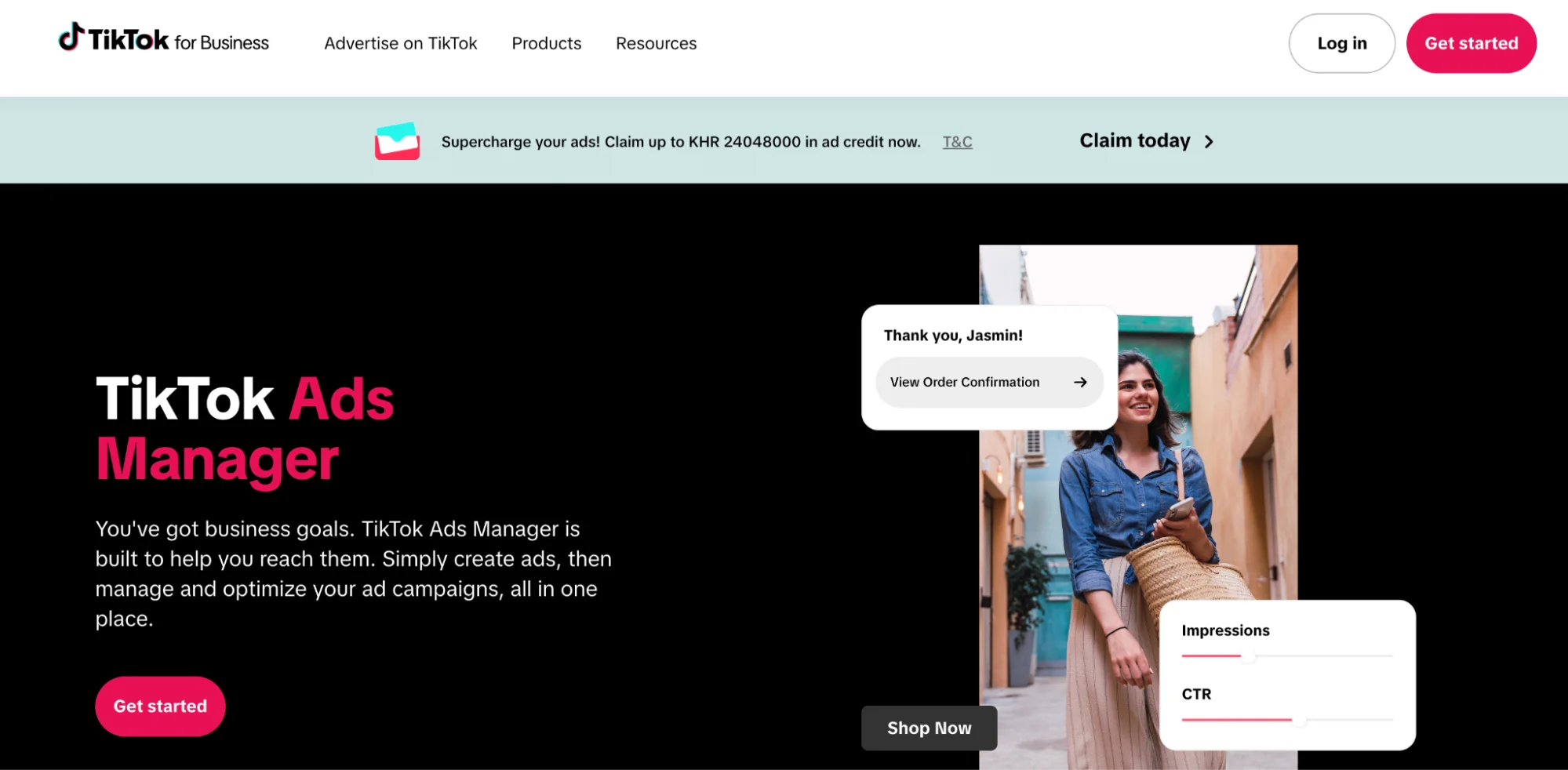
TikTok works best for:
- User-generated content (UGC) style creatives: Authentic, unpolished videos outperform produced ads
- Younger audiences: Strong reach among Gen Z and Millennials
- Awareness and consideration campaigns: Building brand recognition and engagement
- Ecommerce integration: Direct shopping features and Shopify integration
TikTok’s algorithm surfaces content based on engagement, not just follower count, giving newer brands organic reach potential alongside paid campaigns. However, the platform requires a different creative approach—highly produced, brand-forward ads typically underperform compared to native-looking content.
Other top online advertising platforms to consider
Beyond the dominant players, search advertising platforms offer strategic advantages for specific goals, audiences, and industries.
Microsoft Advertising (Bing)
Microsoft Advertising reaches users on Bing, Yahoo, AOL, and partner sites. While Bing holds less than 10% of global search share, Microsoft Advertising often delivers lower CPCs and less competition than Google.
Research suggests Microsoft Advertising CPCs can be 30-50% lower than Google Ads for similar keywords. The platform works well for:
- B2B advertisers: Bing users skew slightly older and higher-income
- Desktop-focused campaigns: Bing has stronger desktop usage than mobile
- Budget-conscious testing: Lower cost per click means more data for the same spend
Microsoft Advertising campaigns can be imported directly from Google Ads, making it easy to expand reach without rebuilding campaigns from scratch.
Why search platforms often drive higher intent
Search advertising captures people actively looking for a solution. Unlike social advertising platforms, where users are browsing passively, search ads answer a declared need. This intent alignment typically results in higher conversion rates and shorter sales cycles, though often at higher CPCs due to competition.
Social advertising platforms (beyond Meta and TikTok)
LinkedIn Ads
LinkedIn Ads is the dominant platform for B2B advertising. With targeting based on job title, company size, industry, and seniority, LinkedIn reaches decision-makers that other social platforms miss.
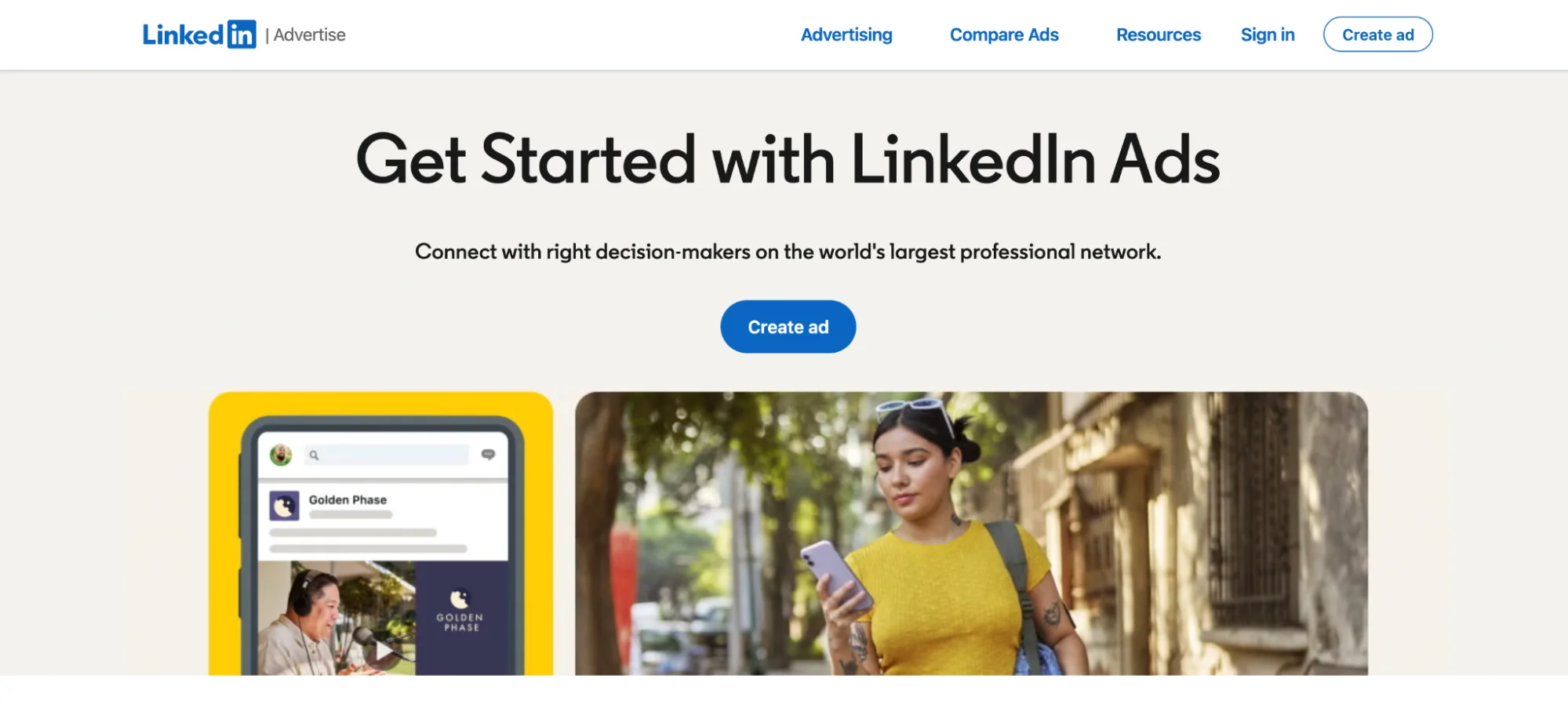
LinkedIn works best for:
- B2B lead generation: Reaching purchasing decision-makers
- High-value products/services: The platform’s higher CPCs justify high LTV offerings
- Thought leadership and content marketing: Distributing whitepapers, webinars, case studies
LinkedIn offers Sponsored Content (native feed ads), Message Ads (InMail), Dynamic Ads, and Text Ads. Expect a higher cost per click than other social advertising platforms, but also higher-quality B2B leads.
💡 Pro tip: For B2B campaigns targeting multiple segments (small business vs enterprise, different industries), Instapage Personalization lets you serve different headlines and proof points to each audience without building separate landing pages.
Pinterest Ads
Pinterest Ads captures users in the discovery and planning phase. People use Pinterest to find ideas for home decor, fashion, recipes, weddings, and travel—making it strong for visual, aspirational products.
Pinterest works best for:
- Ecommerce brands with visual appeal: Home goods, fashion, food, beauty
- Purchase planning cycles: Users often save and return to pins over weeks or months
- Women-focused products: Pinterest’s audience skews heavily female
Pinterest offers Promoted Pins (standard ads), Shopping Ads, Carousel Ads, and Video Pins. The platform’s unique strength is long content lifespan—pins continue generating impressions and clicks long after publication.
Ecommerce and retail media advertising platforms
Amazon Ads
Amazon Ads reaches shoppers at the bottom of the funnel, searching with purchase intent on the world’s largest online retailer. Amazon reports that advertisers see 34% more sales growth within four weeks of launching Sponsored Products campaigns.
Amazon offers:
- Sponsored Products: Keyword-targeted ads appearing in search results
- Sponsored Brands: Banner ads featuring your brand logo and multiple products
- Sponsored Display: Retargeting and audience-based display ads
- Amazon DSP: Programmatic display and video advertising on and off Amazon
Amazon Ads work best for brands already selling on Amazon or willing to use Amazon as a sales channel. The platform captures shoppers ready to buy but requires managing inventory, fulfillment, and on-platform competition.
💡 Pro tip: Match each Amazon product ad to a dedicated product landing page instead of sending traffic to your homepage or generic product category page. Focused pages with product-specific messaging convert significantly better.
Native and open-web advertising platforms
Taboola and Outbrain
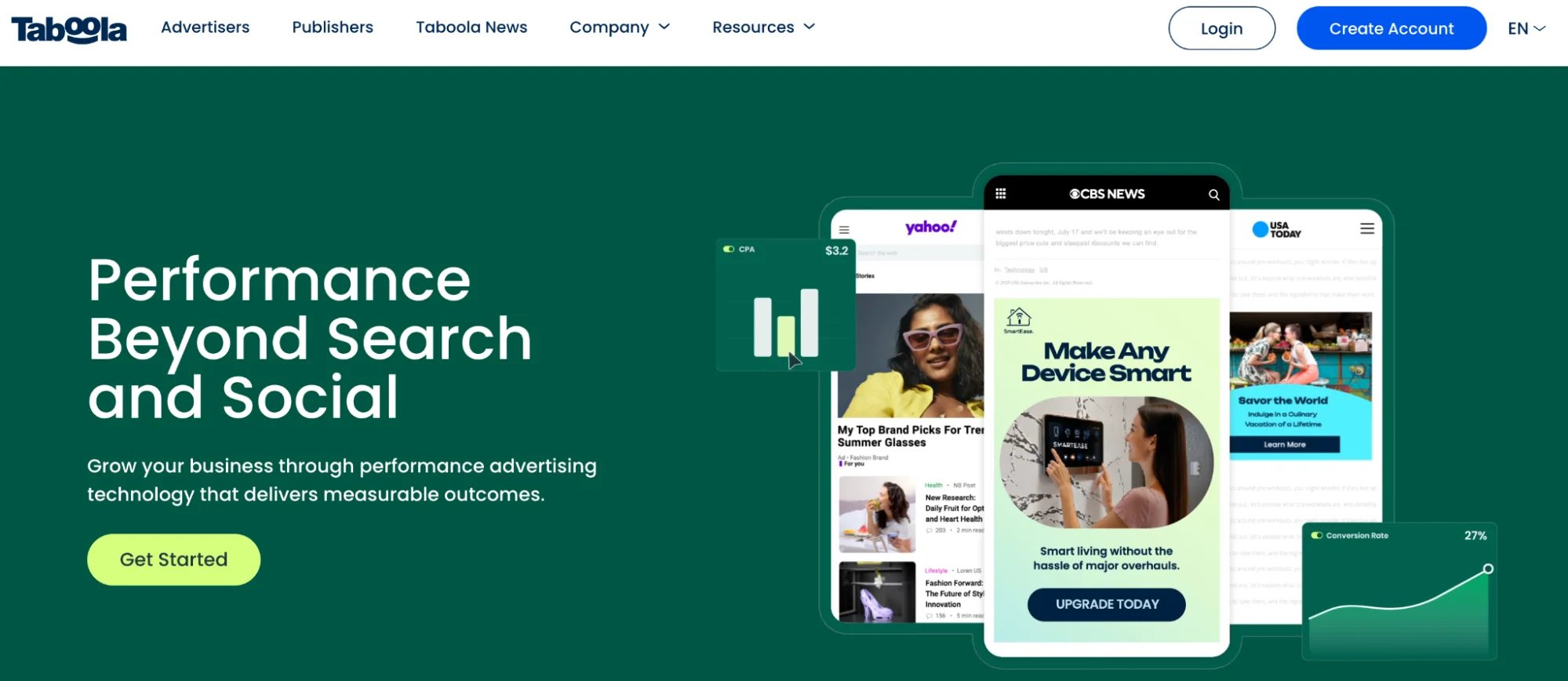
Taboola and Outbrain power “recommended content” widgets on publisher websites. These native advertising platforms place your content alongside editorial articles on sites like CNN, MSN, and major news publishers.
Native platforms work best for:
- Content marketing and advertorials: Distributing blog posts, guides, videos
- Lead generation with longer sales cycles: Capturing emails at the top of the funnel
- Diversification beyond search and social: Reaching audiences in content consumption mode
Native ads require strong alignment with the landing page and clear disclosures. Audiences expect valuable content, not direct sales pitches. Many advertisers use native platforms to build email lists, then nurture leads through email campaigns.
⚠️ Important: Native advertising requires transparent disclosure and strong landing page alignment. Audiences expect valuable content, not direct sales pitches. Use dedicated landing pages that match your native ad’s editorial tone and clearly identify sponsored content. Verify disclosure requirements via official regulator website.
Programmatic and omnichannel platforms
For enterprise advertisers managing complex, multi-channel campaigns, programmatic platforms like The Trade Desk offer unified buying across display, video, CTV (connected TV), audio, and native inventory.
Programmatic platforms work best when:
- You have significant budget (typically $50k+ monthly minimum)
- You need advanced audience targeting across channels
- You have in-house or agency expertise to manage DSP platforms
Most small and mid-market advertisers achieve better results focusing on 2-3 core platforms before expanding into programmatic buying.
How to choose the best platform for advertising (decision framework)
The best platform for advertising depends on several factors. Use this framework to build your platform mix:
1. Start with your primary goal
| Goal | Best Platform Options | Why |
|---|---|---|
| High-intent leads or sales | Google Ads, Microsoft Advertising, Amazon Ads | Search captures people actively looking for solutions |
| Brand awareness | Meta Ads, TikTok, YouTube, Display | Social and video platforms build recognition at scale |
| B2B lead generation | LinkedIn Ads, Google Ads | LinkedIn reaches decision-makers; Google captures problem-aware searchers |
| Ecommerce sales | Google Shopping, Meta Ads, Amazon Ads, Pinterest | Visual platforms and commerce-integrated channels drive product discovery |
| Content distribution | Taboola, Outbrain, Meta Ads | Native and social platforms reward engaging content |
2. Consider your audience
- B2B audiences: LinkedIn, Google Ads (search), Microsoft Advertising
- B2C audiences: Meta Ads, TikTok, Google Ads, Pinterest
- Older demographics (45+): Facebook, Google Ads, Microsoft Advertising
- Younger demographics (18-34): TikTok, Instagram, Snapchat
- High-income professionals: LinkedIn, Google Ads (competitive keywords)
3. Match creative resources to platform requirements
- Limited video production: Start with Google Ads (text), Microsoft Advertising, LinkedIn (static), Pinterest
- Strong video capabilities: TikTok, YouTube, Meta (Reels/Stories)
- Product photography: Meta Ads, Pinterest, Amazon Ads, Google Shopping
- Long-form content: Taboola, Outbrain, LinkedIn (thought leadership)
4. Evaluate budget and competition
- Budget under $5k/month: Focus on one search platform (Google or Microsoft) + one social platform (Meta or TikTok)
- Budget $5k-$25k/month: Add a second channel (LinkedIn if B2B, Amazon if ecommerce, Pinterest if visual products)
- Budget $25k+/month: Test native, programmatic, or additional social platforms
Newer platforms (TikTok, Pinterest) and lower-competition platforms (Microsoft, LinkedIn in some verticals) often provide better initial ROAS while you’re learning.
5. Assess measurement maturity
Start with platforms that integrate easily with your analytics:
- Basic tracking (website conversions only): Google Ads + GA4, Meta Pixel
- CRM-connected tracking: LinkedIn Lead Gen Forms, Meta Lead Ads with CRM integration
- Multi-touch attribution: Platforms with offline conversion import (Google, Meta, LinkedIn)
💡 Pro tip: Once you have conversion tracking in place, use Instapage Experimentation to A/B test landing pages against live traffic and discover what page-level changes improve ROAS across all your platforms.
Avoid spreading budget across too many platforms before you can accurately track conversions. Two platforms measured well outperform five platforms measured poorly.
Privacy, consent, and compliance (2026-ready)
Digital advertising is shifting toward first-party data as third-party cookies phase out. Google Chrome is phasing out third-party cookies (delayed to 2025/2026), iOS privacy changes through App Tracking Transparency limit Meta and other mobile tracking, and browsers like Safari and Firefox already block third-party cookies by default.
This shift means platform tracking becomes less accurate, first-party data like emails, CRM records, and website behavior becomes more valuable, and server-side tracking and conversion APIs become necessary for accurate measurement.
GDPR regulations in Europe require explicit consent for non-essential cookies. CCPA regulations in California require opt-out options for personal data sale. Other jurisdictions including Canada (PIPEDA) and Brazil (LGPD) have similar requirements. Verify specific requirements via official GDPR regulator website and official official CCPA regulator website.
Implement a consent management platform (CMP) that displays compliant cookie notices, respects user choices, integrates with ad platform pixels, and documents consent for audit purposes. Without proper consent management, your tracking becomes unreliable and you risk regulatory penalties.
Build first-party data through email list building (newsletters, content downloads), account creation and logins, customer data platforms (CDPs) that unify web, email, and CRM data, and server-side tracking implementations like Google Tag Manager Server-side and Meta Conversions API. Platforms reward advertisers with strong first-party data through better targeting and measurement.
ROAS improvement happens after the ad click
You can choose the perfect platform, nail your targeting, and write compelling ad copy and still lose money if your post-click experience is broken.
The gap between ad clicks and conversions is where most advertising budgets leak. Here’s why:
Message mismatch kills conversion rate
If your ad promises “Free 14-Day Trial” but your landing page headline says “The Platform Built for Growth,” visitors experience cognitive dissonance. Even minor mismatches between ad copy and landing page messaging increase bounce rates.
The rule: ad headline → landing page headline → CTA should tell one coherent story. The visitor should feel like they arrived exactly where they expected to.
Slow pages drive up cost per acquisition
Research shows that a 1-second delay in mobile page load time can reduce conversions by up to 20%. If you’re paying $8 per click and your landing page takes 5 seconds to load, a meaningful share of your budget evaporates before visitors see your offer.
Fast pages improve both conversion rate and Quality Score (Google) or Relevance Score (Meta), which lowers your cost per click.
1-second delay in mobile page load time can reduce conversions by up to 20%
Generic pages dilute intent
Homepages serve every type of visitor: prospects at every stage, existing customers, job applicants, and investors. They have full navigation menus, multiple competing CTAs, and no singular conversion focus.
A paid traffic visitor declared specific intent by clicking your ad. Sending them to a homepage disperses that intent across dozens of exit points.
Dedicated landing pages built for specific campaigns convert better because they:
- Match the exact message from the ad
- Remove navigation and distractions
- Focus on a single conversion goal
- Load faster (fewer elements, optimized for speed)
How Instapage improves your post-click ROAS on all paid ad platforms
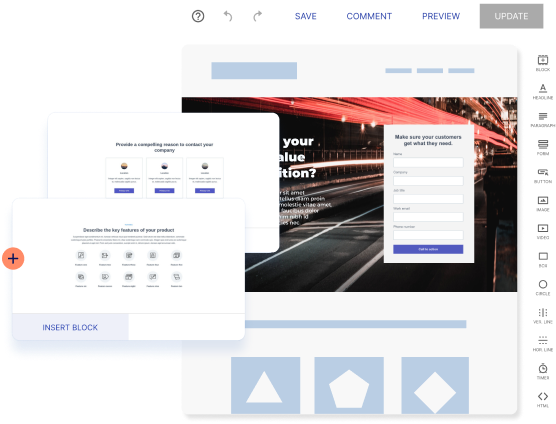
Instapage is built for teams running paid advertising across multiple platforms. Instead of sending all traffic to the same generic page, you can build dedicated landing pages for every campaign using a drag-and-drop builder with 500+ conversion-tested templates. No developer required. Launch pages in hours, not weeks.
Visual campaign mapping through AdMap® lets you see every ad connected to its landing page in one view, identify gaps where ads point to generic pages, and ensure message match across your entire account.
Continuous optimization happens through Instapage Experimentation, where you can A/B test headlines, CTAs, layouts, and offers against live traffic. Discover what page-level changes drive ROAS improvements and build a testing discipline across all platforms.
Audience-specific experiences are delivered through Personalization, which serves different headlines, offers, and social proof to different visitor segments. Match messaging to audience intent without building separate pages and increase relevance and conversion rate for every traffic source.
Instapage customers report an average conversion rate of 16% compared to industry averages of 2-4% for generic pages. Results vary depending on industry, offer, traffic quality, and implementation, but the pattern is consistent: dedicated, message-matched landing pages outperform generic website pages.
See how message match and landing page optimization improve ROAS, start your 14-day trial today.
Frequently Asked Questions
Which online platform is best for advertising?
It depends on your goal, audience, and budget. Most teams start with Google Ads (high-intent search) or Meta Ads (awareness) and expand from there. Test one platform, validate your conversion rate, then add channels with proven measurement.
What are online advertising platforms?
Digital services that let businesses create and manage paid ad campaigns. Examples include Google Ads, Meta Ads, LinkedIn, TikTok, and Amazon Ads. They connect advertisers with audiences using CPC (cost per click), CPM (cost per impression), or CPA (cost per acquisition) pricing.
What are the best online advertising platforms for small businesses?
Start with one search platform (Google Ads or Microsoft Advertising) and one social platform (Meta Ads or TikTok). Use geographic targeting to control budget and optimize your landing page before expanding to additional channels.
What are the top social advertising platforms?
Meta Ads (Facebook/Instagram), TikTok, LinkedIn (B2B), and Pinterest (visual products). The best choice depends on your audience and creative format. Meta offers broad reach, TikTok targets younger audiences, LinkedIn dominates B2B, and Pinterest captures planning intent.
Why do ads get clicks but not conversions?
Message mismatch between ad and landing page, slow load times, generic pages with navigation, weak offers, or poor tracking. Fix this with dedicated landing pages that match your ad, remove distractions, and test headlines and CTAs against live traffic.
Should I advertise on multiple platforms or focus on one?
Start with one platform, validate your offer and conversion rate, then expand to 2-3 platforms with unified tracking. Spreading budget across too many platforms before validating your funnel results in slow learning and poor attribution. Focus beats fragmentation.
Try the world's most advanced landing page platform with a risk-free trial.
